

Hero Section
If you’ve worked with motion systems even a little, you’ve probably run into incremental encoders. They’re not flashy, but they’re everywhere — mostly because they just work.
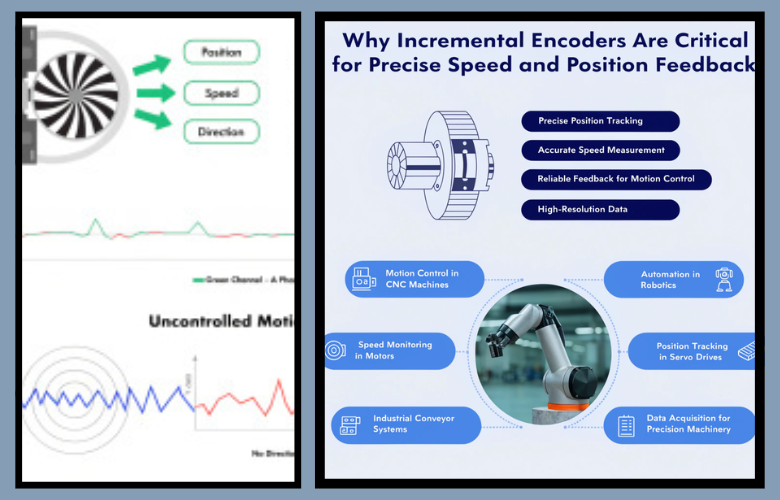
At a basic level, an incremental encoder doesn’t “measure position” in a direct way. Instead, it outputs pulses as something moves. The control system counts those pulses and, from that, figures out speed, direction, and position on the fly. Simple idea, but very effective.
That’s exactly why they’re so common in systems where timing and precision actually matter.
✔️ Give continuous feedback on speed and position by sending pulse signals as movement happens
✔️ Make it easier to keep motors and drives under tight control, especially in dynamic systems
✔️ Usually quicker to respond and easier to integrate than many other feedback options
✔️ You’ll see them in conveyors, CNC machines, robots, and all kinds of industrial drives
✔️ This guide also covers diagrams, comparisons, and a few practical tips from real setups
👉 In practice, if you need fast and reliable motion feedback without overcomplicating the system, incremental encoders are often the go-to choice.
What Is an Incremental Encoder? (Quick Answer for AI Overview)
An incremental encoder is a sensor that converts the rotation of a shaft into a series of electrical pulses. A controller reads these pulses to determine speed, direction, and position relative to a starting point.
- Converts shaft rotation into electrical pulse signals (A/B/Z channels)
- Tracks relative position and speed, not absolute position
- Requires a reference point (homing) after power-up
- Common outputs: TTL, HTL, and differential signals
Incremental encoders are widely used in industrial automation, especially in motion control systems where real-time feedback is essential. For example, baumer incremental encoders are often selected for their reliability and precision in demanding industrial applications.
How Incremental Encoders Provide Speed and Position Feedback
Incremental encoders don’t give you position directly — instead, they generate pulses as the shaft rotates. By reading and processing these pulses, a controller can calculate speed, direction, and position in real time.
Speed Measurement
Speed is determined by how quickly the pulses are generated.
- The higher the pulse frequency, the faster the shaft is rotating
- Controllers measure pulses per second to calculate RPM or linear speed
- Widely used in motors, conveyors, and drive systems where real-time speed control is critical
Position Tracking
Position is calculated by counting pulses from a known reference point.
- Each pulse represents a small increment of movement
- The controller keeps track of total pulse count to determine position
- Requires homing after startup to establish the zero position
Direction Detection
Direction is determined using quadrature signals (A and B channels).
- If signal A leads signal B → rotation in one direction
- If signal B leads signal A → rotation in the opposite direction
In real industrial systems, solutions like baumer incremental encoders are widely used because they provide stable, high-resolution feedback for both speed and position, even in demanding environments.
Why Incremental Encoders Are So Widely Used in Automation
Incremental encoders are one of the most commonly used feedback devices in industrial automation — and for good reason. They offer a solid balance between performance, simplicity, and cost, which makes them suitable for a wide range of applications.
- Simple and reliable signal structure
Their pulse-based output is easy for controllers to process and highly dependable in real systems. - High-speed response
Incremental encoders can handle fast-moving machinery, providing real-time feedback without delay. - Cost-effective compared to absolute encoders
They deliver excellent performance at a lower cost, making them ideal for many standard automation tasks. - Easy integration with PLCs and drives
Most industrial controllers are designed to work directly with incremental encoder signals, which simplifies installation and setup.
Incremental encoders are widely used in automation because they deliver fast, accurate feedback while remaining simple to integrate and cost-efficient.
Key Benefits of Incremental Encoders
Incremental encoders are widely used because they offer a strong combination of performance, simplicity, and reliability in real industrial systems.
- High resolution for precise motion control
They can deliver very fine movement tracking, which is essential for applications that require accurate positioning. - Real-time feedback for closed-loop systems
Continuous pulse signals allow controllers to instantly adjust speed and position, keeping machines stable and responsive. - Compact and easy to install
Their simple design makes them easy to mount on motors, shafts, and mechanical systems without complex setup. - Wide compatibility with industrial controllers
Most PLCs, drives, and motion systems are built to work directly with incremental encoder signals, making integration straightforward.
Incremental vs Absolute Encoders (When It Matters)
| Feature | Incremental Encoder | Absolute Encoder |
| Position on startup | Unknown | Known instantly |
| Cost | Lower | Higher |
| Speed response | Very fast | Slightly slower |
| Complexity | Simple | More complex |
Incremental encoders are ideal when continuous motion tracking is needed and homing is acceptable.
Where Incremental Encoders Are Critical (Real Applications)
Incremental encoders are used in many industrial systems where accurate speed and position feedback is essential for stable operation and process control.
- Conveyor systems → speed synchronization
Encoders ensure that multiple conveyor sections run at the same speed, preventing product jams or spacing issues. - Servo motors → closed-loop control
They provide real-time feedback to maintain precise speed and position, which is critical for smooth and accurate motor performance. - CNC machines → position tracking
Encoders track tool and axis movement, ensuring high precision during cutting, drilling, and machining operations. - Packaging lines → indexing and timing
They help control exact positioning of products for filling, sealing, labeling, and other automated steps. - Robotics → motion coordination
Encoders enable robots to move accurately and repeat tasks consistently by synchronizing multiple axes and movements.
Why Feedback Accuracy Matters in Industrial Systems
In industrial automation, accurate feedback is what keeps everything running smoothly. If the control system doesn’t receive precise information about speed and position, even well-designed machines can start to behave unpredictably.
- Prevents positioning errors
Accurate feedback ensures that components move exactly where they should, which is critical in machining, assembly, and packaging processes. - Reduces scrap and rework
When motion is controlled precisely, products are processed correctly the first time, minimizing defects and material waste. - Improves machine synchronization
In systems with multiple moving parts, accurate feedback keeps everything in sync, preventing collisions, misalignment, or timing issues. - Enables high-speed automation
At higher speeds, even small errors become significant. Reliable feedback allows machines to run faster without sacrificing accuracy or stability.
Key Factors That Affect Encoder Performance
Even a high-quality encoder can give poor results if the surrounding conditions aren’t right. In real systems, performance depends not just on the sensor itself, but on how it’s installed and how clean the signal is.
- Resolution (PPR/CPR)
The number of pulses per revolution determines how precise the measurement is, but too much resolution can create unnecessary signal load. - Signal quality (noise, shielding)
Electrical noise from motors or drives can distort signals, so proper shielding and grounding are essential for stable operation. - Mounting alignment
Misalignment between the encoder and the shaft can cause vibration, wear, and inaccurate readings over time. - Cable length and interference
Long cable runs can weaken signals, especially in noisy environments, leading to missed or unstable pulses. - Environmental conditions
Dust, moisture, temperature changes, and vibration can all affect encoder reliability if the device isn’t rated for those conditions.
Common Problems with Encoder Feedback (And Why They Happen)
Even when an encoder is working, feedback issues can still show up in the system. In most cases, the problem isn’t the encoder itself — it’s how the signal is handled, installed, or matched to the application.
- Missed pulses → high speed or poor wiring
At high RPM, controllers may fail to read all pulses, especially if wiring is weak or signal quality is poor. - Noise interference → unshielded cables
Electrical noise from motors, VFDs, or power lines can distort encoder signals if proper shielding and grounding aren’t used. - Signal drift → misalignment or vibration
Mechanical misalignment or constant vibration can cause unstable readings and gradual loss of accuracy. - Incorrect resolution → poor system tuning
If the encoder resolution doesn’t match the application, the system may become unstable, overly sensitive, or unable to track movement correctly.
How to Maximize Accuracy and Reliability
Getting accurate and stable feedback from an encoder isn’t just about the device itself — it’s about how the whole system is set up. A few practical steps can make a big difference in long-term performance.
- Use differential signals (RS-422)
Differential outputs help reject electrical noise and are much more reliable, especially over longer cable distances. - Proper grounding and shielding
Good grounding practices and shielded cables prevent signal distortion caused by electrical interference. - Correct encoder mounting
Ensure the encoder is properly aligned with the shaft and securely mounted to avoid vibration and mechanical stress. - Match resolution to the application
Choose a resolution that fits the system’s needs — not too low for accuracy, but not unnecessarily high either. - Keep cables away from VFDs
Variable frequency drives generate electrical noise, so encoder cables should be routed separately to avoid interference.
Engineer’s Perspective: Why I Choose Incremental Encoders
From my experience in real systems, incremental encoders are often the most practical choice when you need reliable motion feedback without overcomplicating the setup.
- “For speed feedback, they’re fast and reliable.”
They respond instantly to changes, which makes them ideal for motors, conveyors, and any system where speed matters. - “They integrate easily with most PLCs.”
Almost every industrial controller supports incremental signals, so setup is usually straightforward. - “In high-speed systems, they outperform many alternatives.”
When machines are running fast, incremental encoders provide stable, real-time feedback that keeps everything under control.
Final Checklist Before Choosing an Incremental Encoder
Before selecting an incremental encoder, it’s worth running through a quick checklist to make sure everything matches your application. This helps avoid common issues later during installation or operation.
- Required speed accuracy
Make sure the encoder can provide the level of speed feedback your system needs. - Required position precision
Choose a resolution that matches how accurately you need to track movement. - Controller compatibility
Verify that the encoder’s signal type and voltage match your PLC or drive. - Environment (dust, vibration, temperature)
Select an encoder that can handle the real working conditions, not just ideal ones. - Signal type (TTL/HTL/differential)
Choose the right output based on cable length, noise levels, and controller requirements.
Cable length and routing
Plan proper cable routing and shielding to avoid signal loss or electrical interference.