Applications to the UK’s leading universities continue to reach record levels, but success brings new challenges. Russell Group universities, renowned for world-class research and graduate employability, are now facing increasing pressure on teaching space, student housing, libraries, and academic support services. As domestic applications remain strong and international enrolment grows, questions are being raised about whether infrastructure has kept pace with demand. Understanding Russell Group universities overcrowding helps prospective students make informed decisions while highlighting the wider challenges facing UK higher education.
Overcrowding at Russell Group universities is not just a logistical issue; it has real consequences for the quality of education, student well-being, and overall campus experience. Students often report difficulties finding study spaces, accessing library resources, and engaging in one-on-one interactions with faculty. These challenges are particularly pronounced in larger urban campuses, where housing and classroom space are limited. Addressing Russell Group universities overcrowding is essential for maintaining educational standards while continuing to offer access to high-quality higher education.
What Are Russell Group Universities?
Russell Group universities are an association of the UK’s leading research-focused universities. Established in 1994, the group represents institutions that prioritize academic excellence, research output, and global collaboration. Collectively, they account for more than 60% of the UK’s research funding, producing a substantial proportion of the country’s top-level research publications.
These universities are considered the gold standard for students seeking career opportunities in competitive sectors such as finance, law, medicine, engineering, and technology. The academic prestige of Russell Group universities contributes to their global appeal, which in turn drives high application numbers. This surge in student interest is one of the primary factors behind Russell Group universities overcrowding, as institutions attempt to accommodate both domestic and international students while maintaining high-quality teaching and research standards.
| Statistic | Data |
|---|---|
| Russell Group members | 24 |
| UK research funding received | Around 65% |
| Share of UK graduates | Approximately 30% |
| International students | Hundreds of thousands across member universities |
| Founded | 1994 |
Causes of Russell Group Universities Overcrowding
1. Increasing Domestic and International Demand
One of the main causes of Russell Group universities overcrowding is the growing demand from both UK and international students. These universities are highly ranked globally, making them desirable destinations for ambitious students seeking quality education and strong career prospects. International students, particularly from countries such as China, India, and Nigeria, contribute significantly to campus population growth. This increased enrollment places additional pressure on lecture halls, libraries, and student services.
2. Removal of Student Number Caps
The removal of student number caps in England in 2015 allowed universities to admit more students than previously permitted. While this policy increased access to higher education, it also contributed directly to overcrowding at Russell Group universities. Institutions expanded enrollment to attract more students and generate additional tuition revenue, often without a proportional increase in campus infrastructure.
3. Financial Pressures and Expansion of Courses
Russell Group universities face rising operational costs while maintaining high-quality research programs. To manage these financial pressures, many universities have expanded undergraduate and postgraduate programs. Popular fields such as medicine, law, business, and computer science experience particularly high enrollment numbers, exacerbating in classrooms and campus facilities.
Russell Group Universities UK List
The Russell Group includes 24 world-leading universities across the UK that are known for their strong academic programs and research contributions.
- University of Oxford
- University of Cambridge
- Imperial College London
- University College London (UCL)
- London School of Economics and Political Science (LSE)
- King’s College London
- University of Manchester
- University of Edinburgh
- University of Bristol
- University of Warwick
- University of Birmingham
- University of Glasgow
- University of Leeds
- University of Sheffield
- University of Nottingham
- Newcastle University
- Durham University
- University of Southampton
- University of York
- University of Liverpool
- Queen Mary University of London
- Cardiff University
- University of Exeter
- Queen’s University Belfast
These universities are often considered the UK equivalent of the Ivy League in the United States because of their academic prestige and research output. Many global companies prefer graduates from Russell Group universities because they are known for strong analytical, research, and leadership skills. The universities also receive a large share of UK research funding, which allows them to maintain cutting-edge laboratories and academic programs.
Another reason these universities attract so many students is the global recognition of their degrees. Employers across Europe, North America, and Asia often value qualifications from Russell Group universities. This global reputation leads to very high application numbers each year, which contributes to increasing pressure on infrastructure and teaching capacity. As a result, Russell Group universities overcrowding has become an important issue that universities must manage carefully.
Russell Group Universities Ranking
Russell Group universities dominate many international ranking tables due to their research performance and academic excellence. Institutions like Oxford, Cambridge, and Imperial College London frequently rank among the top 10 universities in the world. Universities such as UCL, Edinburgh, and Manchester also appear regularly in the top 50 global rankings. These rankings reflect strong research productivity, international collaborations, and high student satisfaction rates.
Academic rankings are influenced by several factors including research citations, teaching quality, global reputation, and graduate employability. Russell Group universities score highly in all these areas because they invest heavily in research and innovation. They also attract internationally recognized professors and researchers who contribute to major scientific discoveries. As a result, students studying at these universities often gain access to world-class education and networking opportunities.
However, the strong global ranking of these universities also increases demand from students worldwide. Thousands of applicants compete for limited seats every year, particularly in popular programs such as medicine, law, engineering, and economics. This intense demand can contribute to the ongoing issue of Russell Group universities overcrowding, especially in large lecture courses and student accommodation.
Impacts of Overcrowding on Students and Staff
Academic Challenges
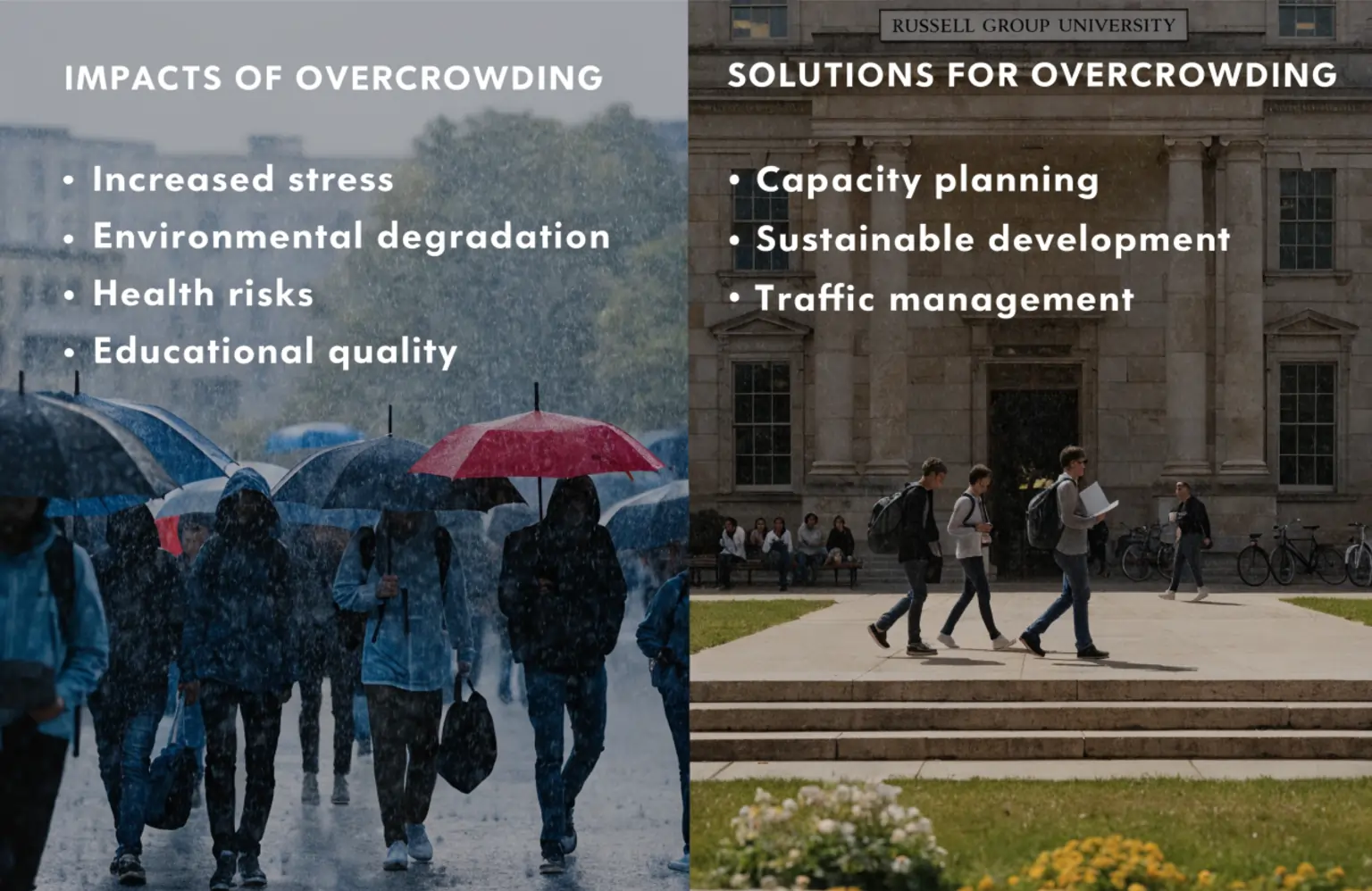
Overcrowding significantly impacts the learning environment. Lecture halls with hundreds of students reduce opportunities for interactive learning, one-on-one consultation, and discussion-based teaching. Students may struggle to ask questions or engage with faculty, which can affect comprehension and academic performance. Additionally, limited access to specialized laboratories and equipment can hinder practical learning for STEM students.
Housing and Campus Life
Student accommodation shortages are a visible consequence of Russell Group universities overcrowding. In cities such as London, Manchester, and Edinburgh, demand for university housing often exceeds supply. Many students must seek private rentals or live far from campus, increasing travel time and cost. Overcrowding also affects communal spaces such as libraries, study rooms, and cafeterias, impacting overall campus life and student well-being.
Faculty and Staff Strain
The pressure on teaching staff is another critical effect of overcrowding. Professors and lecturers must manage larger classes, which can reduce the quality of feedback and academic support. Administrative staff are similarly affected, facing higher workloads in student services, accommodation management, and campus operations. This can lead to burnout and challenges in maintaining educational standards
Solutions to Russell Group Universities Overcrowding
Expanding Infrastructure
Universities are responding by investing in new buildings, lecture halls, research facilities, and student accommodation. For example, many Russell Group institutions have launched multi-million-pound construction projects to meet growing demand. These developments aim to reduce the pressure on existing facilities and provide students with better study and living conditions.
Digital and Hybrid Learning
Another solution to overcrowding is the adoption of digital and hybrid learning models. Online lectures, virtual tutorials, and blended learning approaches allow universities to accommodate larger student numbers without requiring additional physical classroom space. These models also provide flexibility for students, particularly those who live off-campus or overseas.
Controlled Enrollment Strategies
Some Russell Group universities are carefully managing admissions to align student intake with available resources. By monitoring enrollment numbers, adjusting course sizes, and expanding support services, universities aim to reduce the negative impacts of overcrowding while maintaining high educational quality.
Also Read:Spotted in Yate Today Real Time Police Incidents Local News and Community Updates
FAQ:
Q1: What is meant by Russell Group universities overcrowding?
Russell Group universities overcrowding occurs when student enrollment exceeds the available resources, such as lecture halls, libraries, housing, and study facilities. It affects student learning experiences and campus life.
Q2: Which universities are part of the Russell Group in the UK?
There are 24 universities in the Russell Group, including Oxford, Cambridge, UCL, Imperial College London, Manchester, Edinburgh, and Bristol. These institutions are research-intensive and highly prestigious.
Q3: Why are Russell Group universities so overcrowded?
Factors include increasing domestic and international student demand, removal of student number caps, popular courses with high enrollment, and financial pressures driving universities to expand student intake.
Q4: How does overcrowding affect students?
Overcrowding can lead to larger lecture halls, limited library access, housing shortages, reduced interaction with faculty, and strain on campus amenities, which may impact academic performance and well-being.
Q5: What measures are universities taking to reduce overcrowding?
Solutions include expanding campus infrastructure, adopting digital and hybrid learning models, and managing admissions strategically to ensure a sustainable student-to-faculty ratio.
Q6: Is overcrowding only an issue for undergraduate students?
No, overcrowding also affects postgraduate and research students, especially in labs, libraries, and specialized facilities, where access can become limited due to high student numbers.
Conclusion
The Russell Group universities remain the best institutions in terms of providing higher education in the United Kingdom as a result of their excellent education programs, research accomplishments, and successful graduates. Nevertheless, the current problem of Russell Group Universities Overcrowding presents additional difficulties that universities, politicians, and students cannot overlook. Growing numbers of students have put additional strain on lecture theaters, accommodation, libraries, laboratories, and other facilities.
Nevertheless, overcrowding at these institutions does not mean that studying at such universities is less valuable. On the contrary, most universities invest in building new teaching facilities, housing for students, and even expanding campuses. Moreover, most universities are implementing new digital technologies in teaching. Thus, well-organized students will be able to obtain an excellent education and personal experience.